
Writing and Rhetoric Faculty Member Named UM’s Top Online Instructor
Through leading a class of ‘digital explorers’ Colleen Thorndike honored with Paragon Award for 2025-26
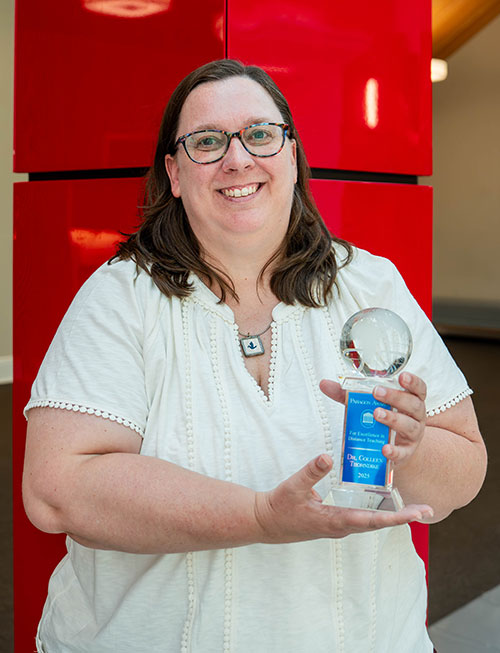
OXFORD, Miss. – This month, Colleen Thorndike, a lecturer in the University of Mississippi’s Department of Writing and Rhetoric, was awarded the Paragon Award for Distance Learning Teaching as the 2025-26 Ole Miss Online instructor of the year.
Now in its 16th year, the purpose of the UM Paragon Award is to recognize UM faculty who use online learning technology effectively through good practices in course design, show an innovative use of technologies that transcends traditional classroom instruction and excel in their commitment of providing a quality education to students.
The award comes with a $1,000 prize.
“Dr. Thorndike’s course didn’t stand out in just one category—she excelled in all of them,” Molly Coleman, associate director of the UM Office of Academic Outreach, said during the annual award and recognition luncheon for Ole Miss Online faculty members held this month at the UM Jackson Avenue Center.
“Her consistent communication and clearly articulated expectations in this course reminded students that there was a real human behind the screen, supporting them every step of the way.”
Coleman said that Thorndike has been a long-standing champion of online teaching best practices at UM as well as an educator who continues to elevate what online learning can be.
Thorndike’s award-winning online course, DMS 101 “Introduction to Digital Media Studies” was designed to give students a comprehensive overview of today’s digital media landscape and introduces them to current ideas and debates within the field.
“You really have to be more intentional in trying to connect with students through a variety of ways in an online course,” Thorndike said. “I work to make sure that students understand why they are doing the work that is asked of them each week and how it will build on what they learn throughout the semester.
“I try to be transparent, to help students understand the weekly work is actually teaching them something, so that it doesn’t feel like busy work.”
Thorndike arrived at UM in 2014 as she was completing her doctorate degree in English from Kent State University. She has taught a variety of writing courses, including Writing 102 and 350 throughout her time at the University.
She first taught “Digital Media Studies” as a live course at UM in 2019, but quickly realized she preferred teaching this subject matter online.
“Students are thinking of how they will use digital content creation and AI (Artificial Intelligence) tools in their future careers, and they continue to want to learn more about this ever-evolving field,” Thorndike said.
To help students manage the workload of an online course in an effective manner, Thorndike set up a grading system through research with previous online courses and with the help of students.
The outcome of her research was an easy-to-follow grading rubric that showed students exactly what work would be required to secure a particular letter grade.
“I surveyed online students and there was feedback asking for more transparency about how to achieve a specific grade a student may want to make in an online course,” Thorndike said.
“I think it helps students not to get as stressed about the workload in the course, because there is a clear path so students know what they must do each week to earn the grade they want to make.
“They know where they stand in terms of their grade at any time depending on what work they have left to do in the class.”
Thorndike says she sends out messages throughout the semester to remind students of projects that are due and what is needed each week to earn the grade they are working toward.
“I think using this expectations scale also mimics what students might see when they are finished at the University and are out in the workforce where they may have benchmarks that they need to meet in their job performance,” Thorndike said.
“I hope this course is preparing them in a way for this.”
Thorndike said that the use of Artificial Intelligence is another theme intertwined in this course. She explained that she does see some trepidation from students that are worried about AI claiming jobs that they could potentially vie for in the future.
“It’s tricky,” Thorndike said.
“I try to toe the line between showing students how to use AI ethically and making sure they are not using it to replace their own thinking.
“I let them experiment with using AI to help them, but I also want them to see the limitations of AI and how it really can’t replace what they can do and what they can offer to a job. We want to keep the human touch.”
In student evaluation responses for Thorndike’s online course, one student commented that the class was more analytical and philosophical than they had thought it would be.
“It was less of a technical manual and more of a critical thinking boot camp for the digital age.”
Another class member discussed how they felt that this course had helped them to consider what’s happening behind the scenes of online content.
“Every time you log-on, scroll, or post you start to notice how what we see online reflects our thinking and behavior, but also how it shapes what we think and how we are reacting.”
When developing this course, Thorndike made it a point to give students various choices throughout the syllabus to keep them engaged.
An example of student choice in her course was allowing students to choose two short podcast episodes related to their interests, major, or future career and discuss them with the class in the weekly discussion board.
“I figured an online class would be a pretty solo experience,” one student said. “The discussion boards were the real heart of the class.
“Everyone was able to bring up their own unique online experiences. Seeing how my peers reacted to topics like social media issues helped make it feel more like a community of digital explorers than a class of isolated students.
“Coursework felt less like a chore and more like a conversation I was already interested in having.”
Stephen Monroe, chair of the UM Writing and Rhetoric department pointed out that Thorndike’s engaging lessons were very useful to students in today’s digital world.
“She is a terrific teacher and very deserving of this recognition.”
Thorndike said she keeps working to find new ways of approaching the courses she teaches so that the course material stays fresh for not only the students, but also for herself.
“One thing I believe is that my education is never complete. The more I can learn about different teaching styles and techniques, the better teacher and coach I will be to my students.”